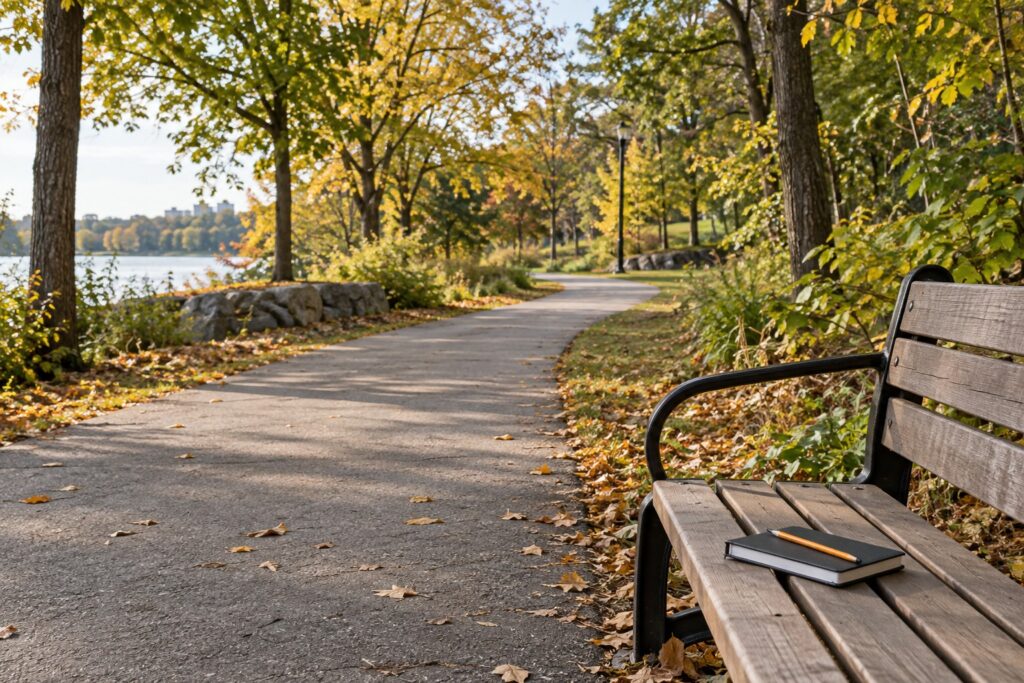
A seasonal walk can be meaningful without bringing anything home. You can build a practice around noticing, sketching, and remembering rather than harvesting plants or leaving objects outdoors. This five-stop exercise works on a city block, an accessible park route, a familiar path, or a sequence of views from windows when going outside is not possible.
Choose a route that fits today
Pick a route you know and can comfortably complete. Check the conditions, choose appropriate clothing, and keep your attention on traffic and your surroundings. Do not walk somewhere isolated merely because it seems more magical. Five pauses on one short route are enough; the practice does not require distance or endurance.
Carry a small notebook or use a voice memo after stopping somewhere safe. If you prefer not to record anything during the walk, remember one word from each pause and write afterward. A photograph is optional, and it should not distract you from navigating the route.
Stop one: arrival
Notice your starting point. Name something ordinary that helps you orient yourself: the door behind you, a familiar sign, or the direction of the light. Ask, “What am I bringing into this walk?” Answer plainly. You may be tired, curious, distracted, or simply glad to be outside. You do not need to transform that feeling immediately.
Stop two: what is changing
Look for a change you can actually observe. It might be a plant, a puddle, a different shop display, or a shift in the sounds around you. Separate observation from assumption. “The branch is bare” tells you more reliably what you saw than a story about why it became bare.
Ask what change in your own week needs acknowledgment. Keep the answer small enough to name without solving it on the spot.
Stop three: what is holding steady
Find something familiar: a building, a repeated route, the shape of a hill, or a routine happening nearby. Use it as a prompt to name one support in your life. The support could be a friend, a regular meal, a useful habit, or a place where you can rest. If none comes to mind, write what kind of support you need.
Stop four: what deserves a boundary
Pause where you can think safely. Ask, “What have I been giving more time than I intended?” Choose one concrete boundary, such as ending work at a set time or declining an extra obligation. You are using the walk to clarify a choice, not interpreting the landscape as an authority over your decisions.
Stop five: return
Before finishing, choose one action for the next twenty-four hours. Make it visible and manageable: send the message, put the notebook beside your bed, or schedule the errand. When you get home, record the five words you chose and the action. The return is part of the practice rather than an interruption of it.
Leave the route as you found it
No plant identification, tasting, or collection is needed. Stay where access is permitted, leave wildlife alone, and avoid placing salt, food, wax, or other offerings outdoors. A written note kept with you can carry the meaning of the walk. If you want a material reminder, draw a detail from memory instead of taking it.
Adapt the pauses to a seated observation session whenever that suits your body or circumstances better. Continue the reflections in an ongoing seasonal journal, or use the apartment witchcraft guide for practices centered on your immediate surroundings.
Optional Supplies From the Shop
Use what you already have first. If you are looking for supplies, these shop listings relate to the practice above.
- Witch's Field Guide Grimoire Page Bundle — Printable record pages are an optional place to save your five observations after the walk. You can also use plain paper; no collecting or plant identification is required.
Some shop listings use affiliate links. We may earn a commission from qualifying purchases. See our affiliate disclosure.