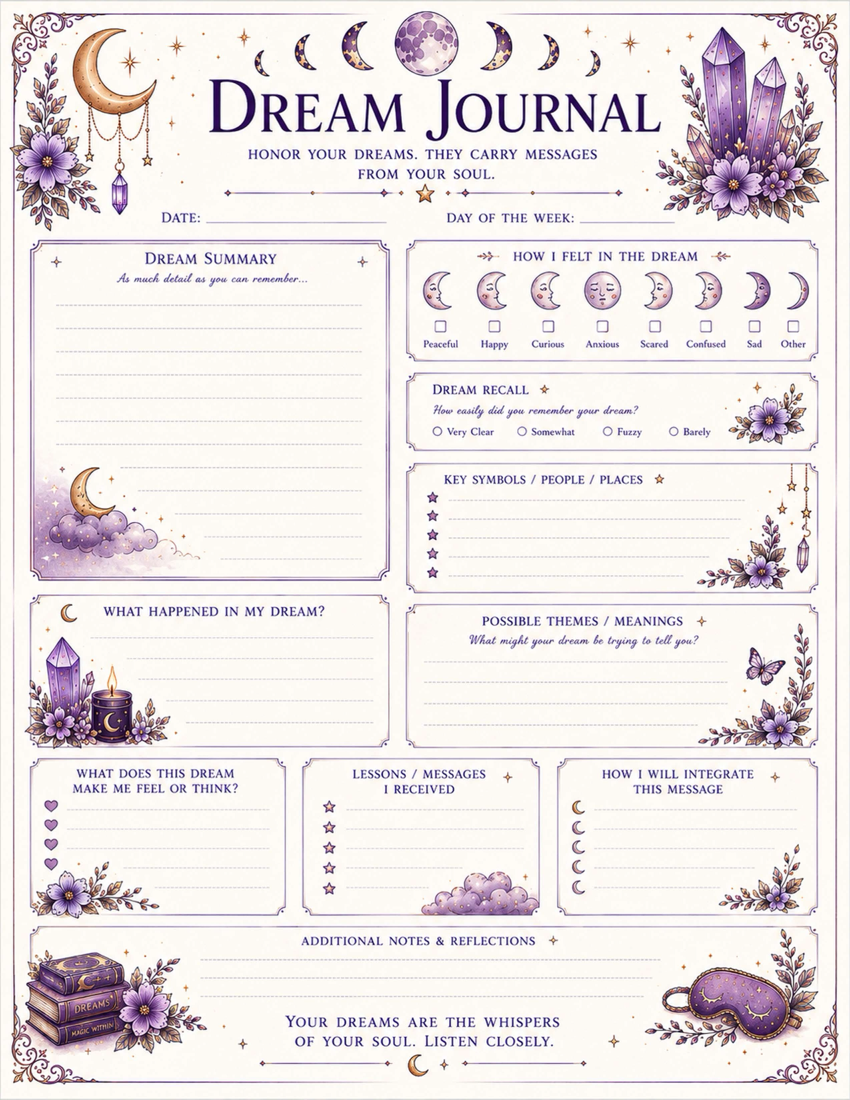
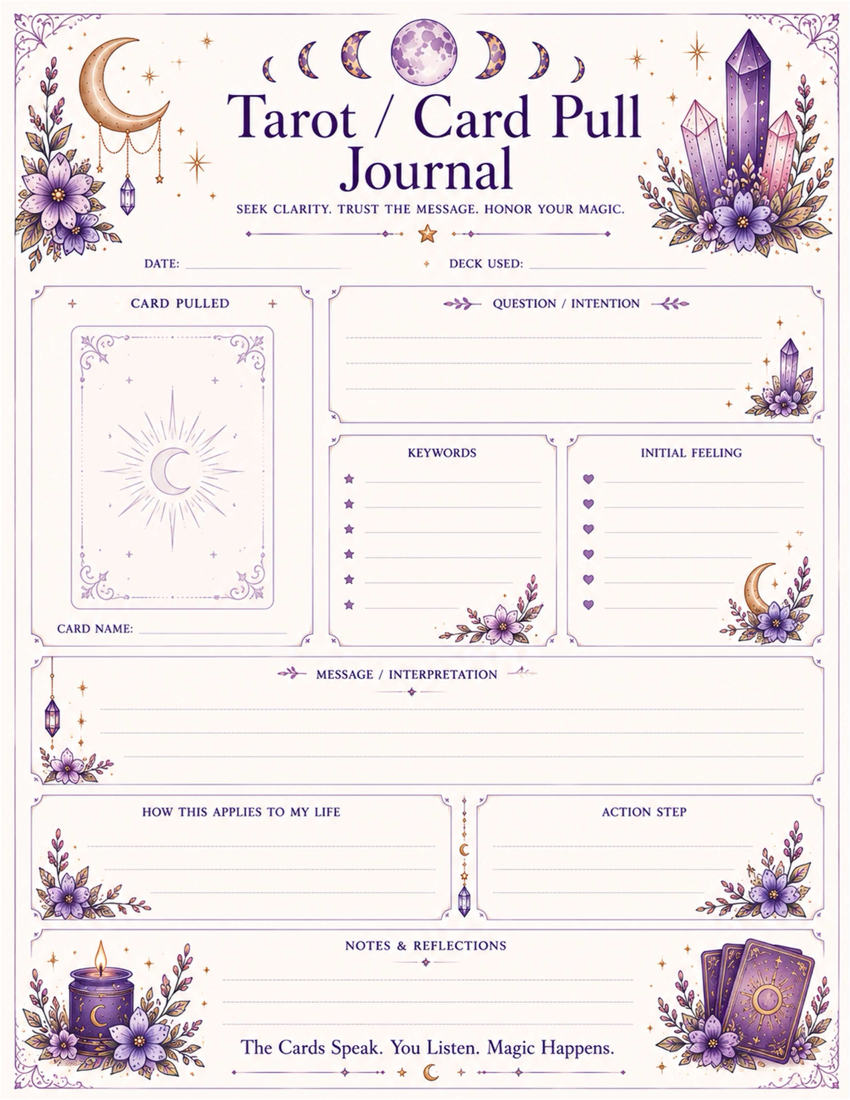
A tarot journal turns a reading from a passing impression into a record you can learn from. The goal is not to prove that every card predicted something. The goal is to track questions, interpretations, emotions, choices, and patterns over time.
Record the question clearly
Write the exact question before drawing cards. Strong tarot questions usually focus on perspective, choice, pattern, or next action. If the question asks for certainty about another person, rewrite it toward what you can know and do.
Add the date, deck, spread, mood, and context. These details help later when you review the reading.
Separate meaning from action
For each card, write the traditional meaning, your first impression, and the action it suggests. This prevents a reading from staying abstract. A card about rest might become canceling a nonessential task. A card about boundaries might become sending a direct message.
If a card feels confusing, write two possible interpretations and check back later instead of forcing certainty.
Review without over-reading
Return after a day, week, or moon cycle. Mark what was accurate, what was projection, and what you learned. Over time, your journal becomes a personal card dictionary shaped by practice.
Practical Checklist
- Write the question before shuffling.
- Record cards, positions, mood, and context.
- Add one practical next step.
- Review on a chosen date.
- Track repeated cards and themes in an index.
Keep Exploring
Use this guide with Tarot Reading Tool, Tarot History and Spreads, Grimoire Page Generator.
Worked Example: One-Card Daily Draw
Before drawing, write the question “What should I pay attention to today?” Pull one card and record the card name, image details that stand out, traditional meaning, and one practical action. If you draw the Eight of Pentacles, the action might be to focus on one skill instead of multitasking. If you draw Temperance, the action might be to pace the day more gently.
At night, add two lines: what actually happened and what you learned from the card. This review is what turns a daily draw into a study practice instead of a quick aesthetic ritual.
Common Beginner Mistakes
- Asking the same anxious question repeatedly.
- Only writing card keywords and never recording real-life context.
- Ignoring reversals, or treating them as automatically negative.
- Forgetting to review old readings.
What To Record
Track repeated cards, repeated questions, emotional state, moon phase if relevant, and the action you took. Over time, patterns in your journal will teach you more than any single reading.